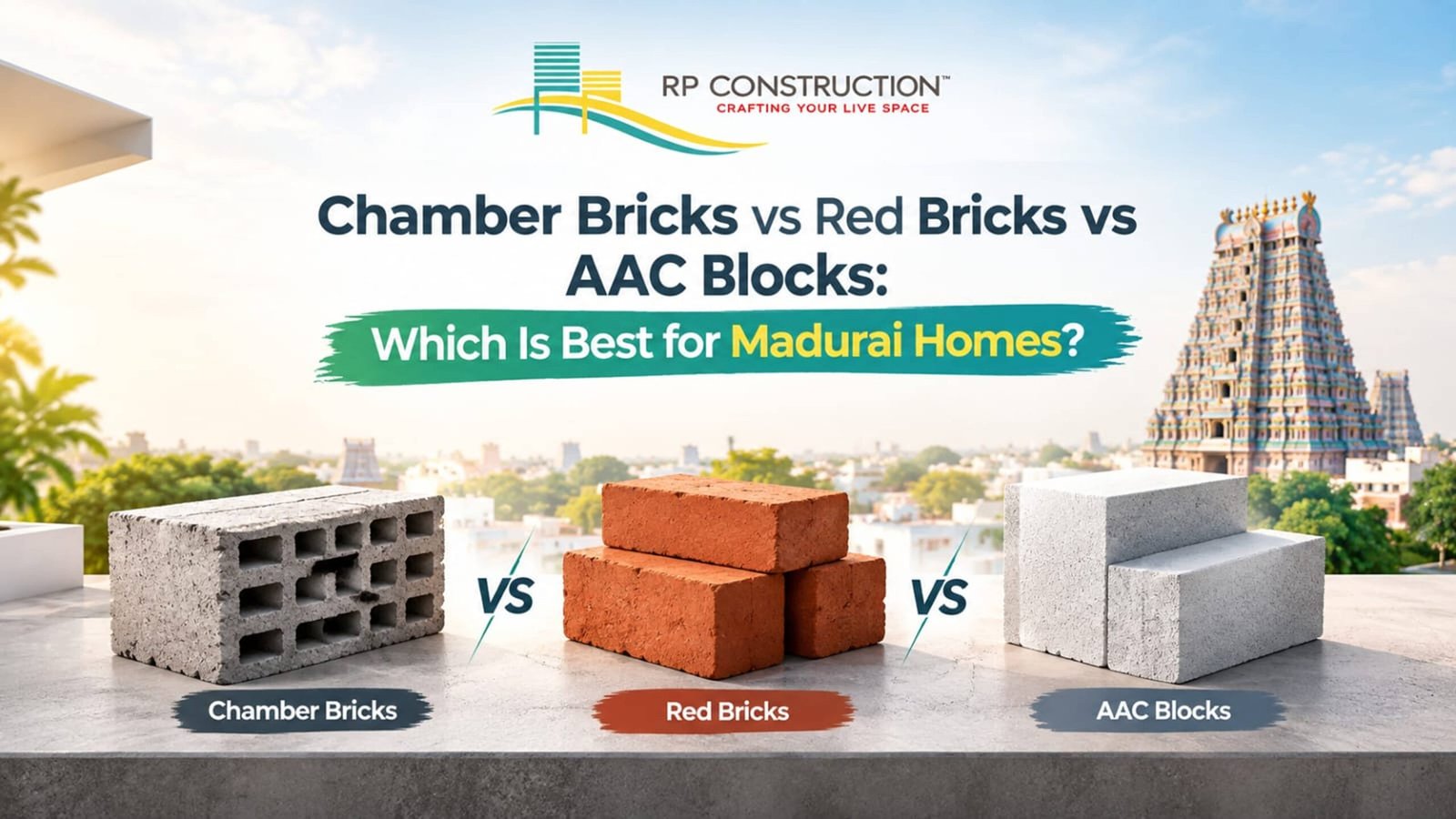
The material you build your walls with affects how strong they are, how hot your rooms get in summer, and how easily you can fix cupboards and fittings later. In Madurai, most homeowners choose between three options: chamber bricks, ordinary red bricks and AAC blocks.
This guide compares all three on strength, weight, heat, durability and cost, and explains which suits which kind of home. It’s also a good question to put to any builder you’re considering: the best construction company in Madurai for your project should be able to explain its choice of wall material clearly.
What each material is
Chamber bricks
Chamber bricks are clay bricks fired in a chamber kiln at a controlled temperature, so the heat spreads evenly through every brick. The result is a uniform size, sharp straight edges and consistent strength from one brick to the next. A standard brick measures about 9 × 4 × 3 inches and weighs roughly 2.5 to 3.5 kg.
Red bricks (country bricks)
Ordinary red bricks use the same clay but are usually hand-moulded and fired in open clamps, where the heat is uneven. Quality varies within a single load: some bricks are well burnt, others under-burnt, with irregular edges. They cost less, but need careful checking.
AAC blocks
AAC (autoclaved aerated concrete) blocks are made from fly ash or sand, cement, lime and an aerating agent, then steam-cured under pressure. The result is a block full of tiny air pockets. They are much larger than bricks, typically around 600 mm long and 200 mm high, in thicknesses from 75 mm to over 200 mm.
How they compare
Strength
In most Madurai homes, the RCC columns and beams carry the building’s load, and the walls fill the spaces between them. In that kind of structure, all three materials are strong enough when laid properly, and your structural engineer decides what’s needed.
Per unit, well-fired clay bricks are stronger than AAC blocks, which are typically rated at 3 to 5 N/mm². That extra strength matters most for load-bearing walls and for walls that will carry heavy fixtures.
Weight
AAC is about one-third the weight of clay brick: roughly 550 to 650 kg per cubic metre for standard blocks, against 1,600 to 2,000 kg for clay bricks. Lighter walls put less load on beams and foundations, which helps most in multi-storey buildings and when adding a floor later.
Heat
This is AAC’s biggest advantage in Madurai’s climate. AAC conducts heat roughly three to five times less than clay brick, so AAC walls keep rooms noticeably cooler and can reduce air-conditioning use, especially on west-facing walls. Clay brick walls absorb heat during the day and release it in the evening.
Moisture and durability
Well-burnt clay bricks are very durable and handle moisture well. Under-burnt country bricks absorb more water, which can lead to damp patches and white salt marks on walls. AAC blocks are porous, so external AAC walls need the right plaster and waterproofing.
Workmanship and fixing
Every mason in Madurai knows how to build with clay bricks, and fixing wall cabinets, TV mounts and AC units into brick is straightforward. AAC blocks lay faster and need less mortar, but they require block adhesive, specific plastering practice and the right anchors for heavy fixtures. Done poorly, AAC walls can develop cracks along the joints.
Cost
Per piece, country bricks are the cheapest. Chamber bricks typically cost 15 to 30% more than ordinary bricks because of the controlled firing. AAC blocks cost more per piece but replace several bricks each, use less mortar and save labour time. Prices change often, so ask your builder to compare the finished wall cost per sq.ft rather than the price per brick or block.
Which is best for your home?
- Chamber bricks suit most independent and G+1 homes, where you want proven strength, easy fixing and workmanship any skilled mason can deliver.
- AAC blocks suit projects where reducing weight matters, such as adding floors or building apartments, or where heat insulation is the top priority. Choose a builder with real AAC experience.
- Country red bricks suit tight budgets only, and every load should be checked before use.
- A combination is also possible. Some builders use AAC blocks for upper-floor partition walls to reduce weight, and bricks elsewhere.
Why every RP Construction package uses chamber bricks
All four RP Construction packages use first quality chamber bricks as standard. They give consistent quality from load to load, hold fixings for kitchen cabinets and wardrobes well, and are familiar to every skilled mason in Madurai. Because civil work is the same in every package, you get the same walls whichever package you choose. See our package comparison for what does change between them.
What the best construction company in Madurai should show you about bricks
Whichever material you choose, ask your builder how they check it on site. For clay bricks, a good brick should:
- Have a uniform size and sharp, straight edges
- Give a clear ringing sound when two bricks are struck together
- Show an even colour with no cracks or black, unburnt cores
- Resist a fingernail scratch
- Absorb no more than about 20% of its weight in water after soaking for 24 hours
For AAC blocks, ask for the manufacturer’s test certificate under IS 2185 (Part 3) and the density grade of the blocks.
Frequently asked questions
Talk to us about your home
Planning a home and want the best construction company in Madurai to guide your material choices? Call RP Construction on +91 98421 51077 or message us on WhatsApp with your plot size and plan.